Rabbet joint
Corner · Visible · Hand or power · Difficulty 2/5
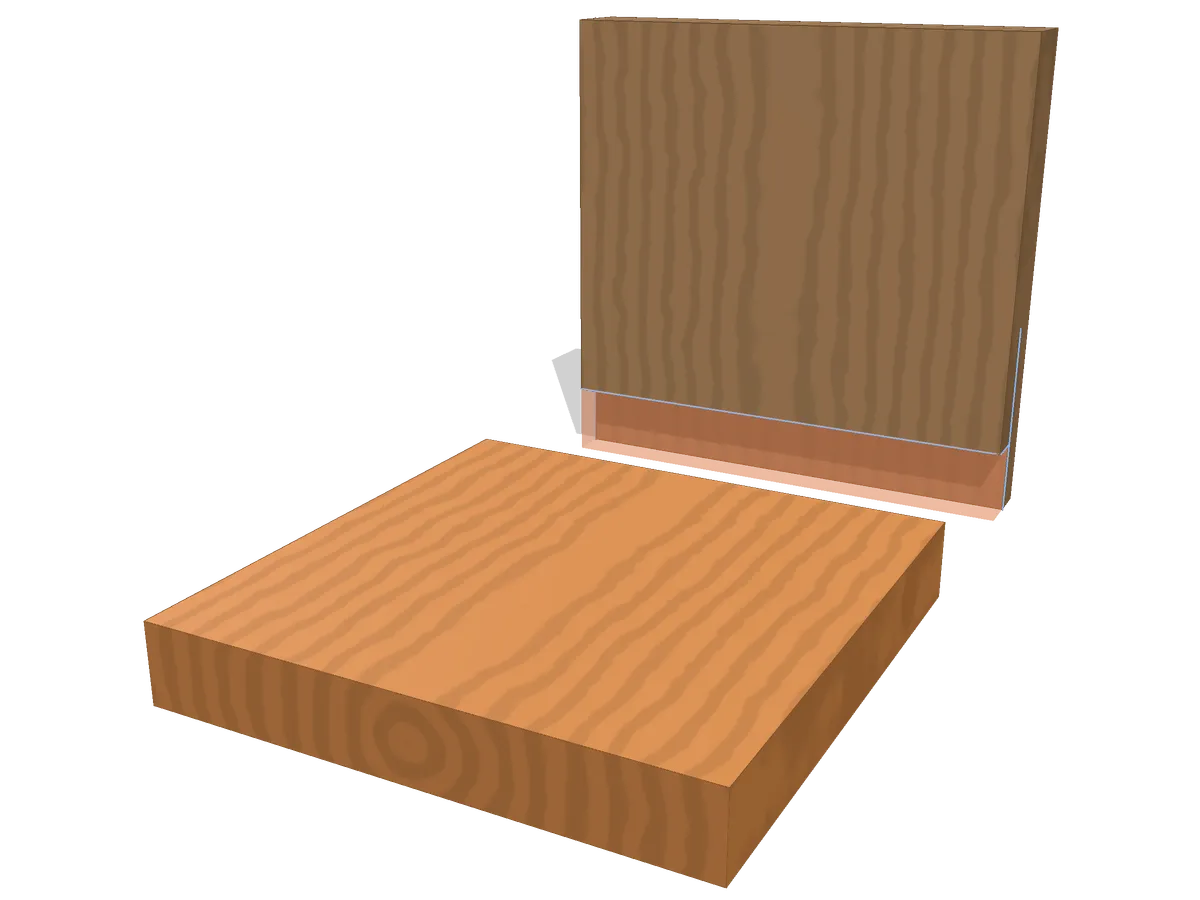
A rabbet joint takes a square step (a rebate, in British usage) out of the end or edge of one board, and the mating board sits into it. The step gives two bearing surfaces instead of one and hides the end grain from one side, while the mating board itself is left square and entirely uncut.
The 3D viewer stopped.
Mark out (1 of 4)
- Also called
- rebate joint, ledge joint
- Family
- Corner · face cut
- Joins
- two boards at a corner
- Typical use
- cabinet backs let into a carcase; drawer bottoms and box lids; simple case corners
- Holds against
- Shear, Racking (qualitative)
- Difficulty
- 2/5
- Tools
- marking gauge, marking knife, rebate plane, tenon saw, wide bevel-edge chisel
On this page
How the parts fit
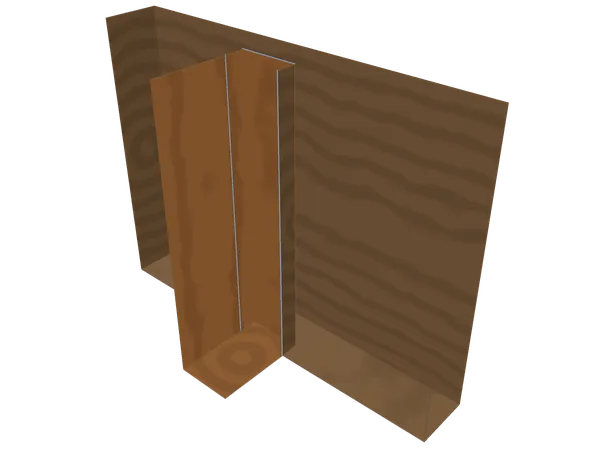
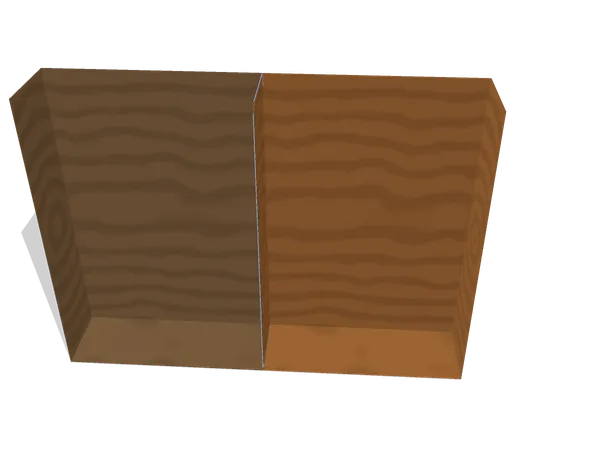
Two surfaces carry this corner: the floor takes the mating board face to face, and the shoulder stops its end and hides it from one side.
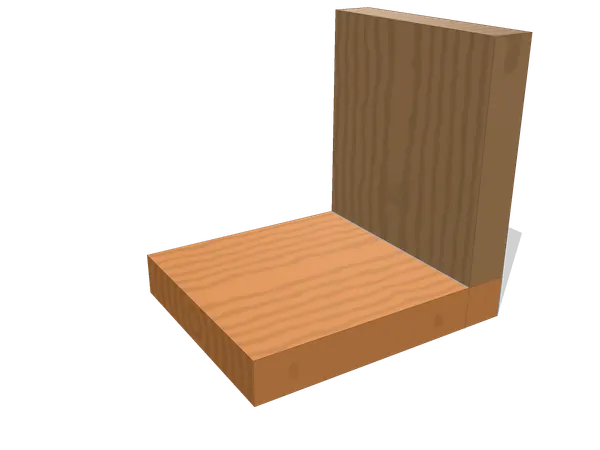
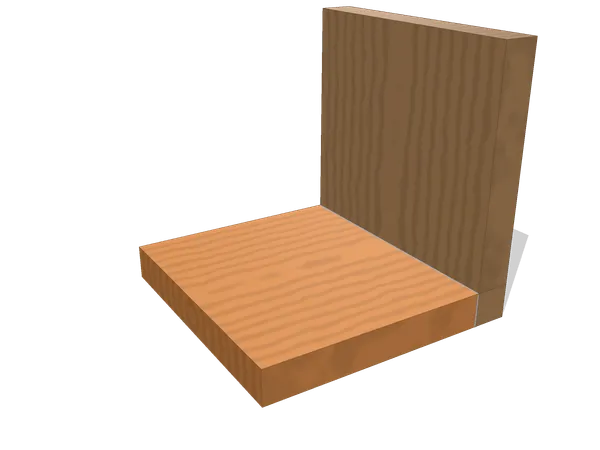
Only one board in a rabbet joint is cut. A step is taken out of its end or edge (a floor and a shoulder meeting at a right angle), and the second board simply sits down into that step, square and unmodified. That asymmetry is the joint’s whole identity: nothing has to be marked or measured on the mating board at all, because the rabbeted board alone decides where the corner registers.
The rabbet’s depth is set by the rabbeted board’s own thickness, but its width is not a separate measurement: it is set by whatever the mating board’s own thickness happens to be, at the default 18 mm11/16 in. Widen the mating board and the recess widens with it, without a second gauge setting anywhere. A 9 mm3/8 in floor is left standing under the step at the joint’s own default proportions, thick enough to carry the load without pulling the shoulder line uncomfortably close to the surface.
Two contacts do the holding. The floor takes the mating board’s inner face across a genuine long-grain area, and the shoulder stops its end from one side, concealing the end grain there while leaving it exposed on the other. Nothing in the shape resists the boards separating along the axis they closed on; a rabbet locates a corner rather than locking it, and it is glue, a screw or a nail that keeps it shut.
When to use a rabbet joint (and when not to)
It is the fastest register between two boards that still gives a real shoulder to close against: cabinet backs let into the rear of a carcase, drawer bottoms and box lids, and any simple case corner where hiding the end grain on one face is enough. One gauge setting and one saw or plane pass are all it takes, which is why it turns up wherever speed matters more than a fully concealed joint.
Along the boards’ own length, a straight pull apart is exactly what a rabbet cannot resist on its own, since nothing about the step opposes it. Thin stock leaves too little material standing under the floor once the rabbet is cut to a useful depth, and it has no place in work where neither face may show any end grain, because one shoulder is always left bare.
Layout and cutting, step by step
A gauge set once to the rabbet’s depth, run along both edges from the face side, carries a single knifed shoulder line across the end, and only that one board carries any marks at all.
- Choose which board is rabbeted; the other stays square and gets no marks at all.
- Set a marking gauge to the rabbet’s depth and run it along both edges of the rabbeted board, always from the face side, so the two lines land at the same setting.
- Knife the shoulder line squarely across the face, at a distance from the end equal to the mating board’s own thickness, and carry it down both edges to meet the depth line.
- Deepen the shoulder line into a shallow wall on the waste side, giving the saw a groove to register in.
- Saw down the shoulder to the depth line, keeping the kerf inside the waste, then take the bulk of the waste off the end in one or two more passes.
- Work a rebate plane along the floor until it reaches the depth line its full width, checking with a straightedge that the floor is flat and the shoulder square to it.
- Dry-fit the mating board into the step. It should sit down fully on the floor with its end grain flush against the shoulder and no rock across the width.
Common mistakes
A board sitting proud of flush is pointing at the floor, not the shoulder: high in the middle, and a straightedge laid across it catches the spot at once.
Gauging the depth line from the back of the board instead of the face side is the fault that shows up latest: the rabbet still looks right until the mating board goes in against the wrong reference and the whole assembly reads out of square. One setting, one face side, checked before the saw touches the wood.
A floor left high in the middle stops the mating board from bedding fully and is easy to miss until the dry fit; a straightedge across the floor catches it before the shoulder does. A shoulder cut a shade shy of square lets the mating board’s end grain meet it at an angle rather than flush, which shows as a sliver of daylight at one edge. Cutting the rabbet too deep leaves the floor fragile and prone to splitting under clamp pressure, while cutting it too shallow leaves the shoulder doing almost nothing: check the depth against the mating board’s actual thickness before committing the saw, not against a number remembered from the last job.
Rabbet joint vs dado, butt and box joints
Use a rabbet when a corner needs one quick register and a shoulder to close against, with only one board cut; a dado, butt or box joint fits a mid-panel shelf, a faster join, or far more glue area instead.
A dado houses a board partway along a panel rather than at its end, closed on three sides instead of open like a rabbet’s single step; the two share a floor-and-wall structure but a dado never leaves a shoulder exposed the way a rabbet’s outer face does.
A butt joint skips the step entirely and lets the two square ends simply meet, which is faster still but gives up the shoulder’s registration and the floor’s glue area, leaning on fasteners or dowels to hold what the rabbet’s own geometry would have located for free.
A box joint cuts both boards into interlocking fingers rather than stepping just one of them, trading the rabbet’s single quick cut for many identical small ones and a corner with far more long-grain contact than one floor and one shoulder can offer.
Variants
Double rabbet. A step is cut into both boards rather than one, each taking half the joint, so the two floors meet in the middle and neither board is left entirely uncut.
Rabbet-and-dado. The rabbeted board’s step drops into a dado cut across the second board rather than onto a flat face, adding a wall on the far side that resists the boards separating sideways as well as apart.
Stopped rabbet. The step is worked to stop short of the board’s front edge, so no open end shows once the corner is assembled, more layout in exchange for a cleaner line on the visible face.
Frequently asked questions
Is a rabbet the same as a rebate?
Yes. Rabbet is the American spelling and rebate the British one, and both name the same square step cut into the end or edge of a board. A stepped joint described either way is this one; only the ledge-joint name is a little less common on either side.
How deep should a rabbet be?
Deep enough to seat the mating board fully, and no deeper: half the thickness of the rabbeted board is a common default, leaving roughly half the stock as a tongue under the step. Too shallow and the shoulder does little; too deep and that tongue becomes fragile.
Does a rabbet joint need fasteners?
Glue alone holds a rabbet in light work, since the floor gives a genuine long-grain gluing surface. Anything load-bearing or handled roughly usually adds a screw or a nail through the step, because the joint has no shape that resists the boards separating along their own length.
What is the difference between a rabbet and a dado?
A rabbet is cut at the end or edge of a board, so it is open on one side; a dado is a trench cut across the middle of a board, closed on three sides. A rabbet registers a corner, a dado houses a shelf partway along a panel.
Sources and revision history
- Noyes, Handwork in Wood (1910), the common joints chapter, No. 24 "A rabbet or rebate or ledge joint" (public domain)
- Wikipedia: Rabbet (terminology and variants)
Revision history
- Published
- Last updated
Related joints
All wood joints
Every joint on the site, live and planned, grouped by how the pieces meet.
Dado joint
A flat-bottomed trench across the grain houses the end of a shelf on three sides.
Butt joint
Two square-cut ends meet with nothing but glue or a fastener holding the line together.
Dovetail joint
Wedge-shaped tails drop between pins so the corner locks mechanically along one axis, not by glue alone.
Box joint
Square fingers alternate across the corner, every one cut to the same width.