Dowel joint
Edge · Hidden · Hand or power · Difficulty 2/5
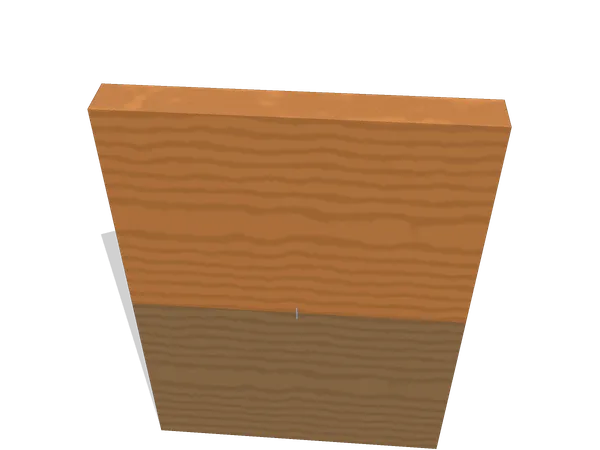
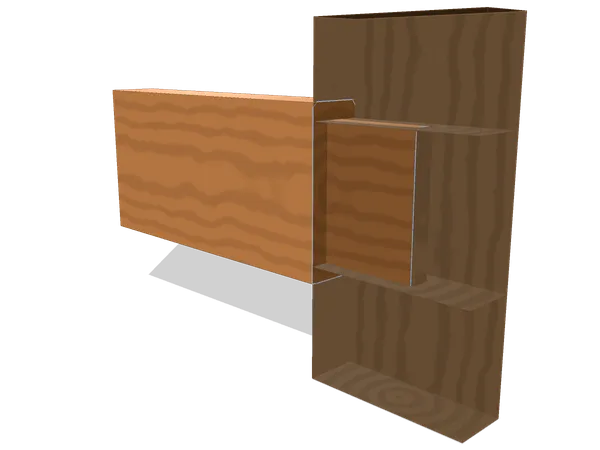
A dowel joint drives round pins into matching blind holes bored across two mating edges, so glue on the long-grain faces does the holding while the pins keep both edges in register as it cures. Nothing about the joint is cut; its whole accuracy lives in where the bores land.
The 3D viewer stopped.
Mark out (1 of 4)
- Also called
- dowelled joint, dowel-reinforced butt joint
- Family
- Edge · socket
- Joins
- two boards edge to edge
- Typical use
- edge-jointed panels and table tops; light frames and carcase alignment; shop-made furniture assembled without cut joints
- Holds against
- Shear (qualitative)
- Difficulty
- 2/5
- Tools
- marking gauge, dowelling jig, brad-point bits, depth stop, clamps
On this page
How the parts fit
Together, the pins vanish and do less work than they appear to: the long-grain edges bear on each other and carry the glue line, while the dowels only hold the two boards in register until it sets.
A dowel joint sets round pins into blind holes bored across two mating edges, one hole for every pin and every hole bored to the same setting as its partner. Nothing about the geometry is cut away to receive them (no shoulder, no socket, no notch), so the two boards still meet as a plain edge joint underneath, and the pins add registration to that meeting rather than a new shape for it to take. A board 19 mm3/4 in thick, by default, carries a dowel a little over a third of that in diameter, bored roughly 15 mm9/16 in deep on each side.
Most of a bore’s own wall ends up as end grain rather than long grain, because the hole is drilled straight into the edge across the growth rings, and end grain takes up glue poorly next to a long-grain face. That is why the pins are described here as locating the joint rather than carrying it: the edge-to-edge contact around them is what actually resists being pulled apart.
When to use a dowel joint (and when not to)
Dowelling suits panel and carcase work where boards need to land flush and stay there while glue cures, and where nothing about the finished piece calls for a mechanical lock against being pulled apart. A tabletop glued up from several boards, a light frame whose corners will be reinforced some other way, or shop furniture that never has to resist a hard pull: all are reasonable candidates, and a dowelling jig makes the whole operation quick and repeatable across many identical joints.
Compared with a mortise and tenon’s shoulder, a dowel’s own bearing area is small, so a corner that has to resist racking on its own is the wrong job for it: nothing about the round pin stops the joint twisting the way a flat cheek does. It also asks for square, accurately bored holes, which is a hard thing to guarantee freehand, and a joint whose edges cannot be held still and square under a drill is a poor place to reach for dowels. Very thin stock is a third reason to look elsewhere: a pin needs real wall around it on both faces, and thin material leaves barely enough.
Layout and cutting, step by step
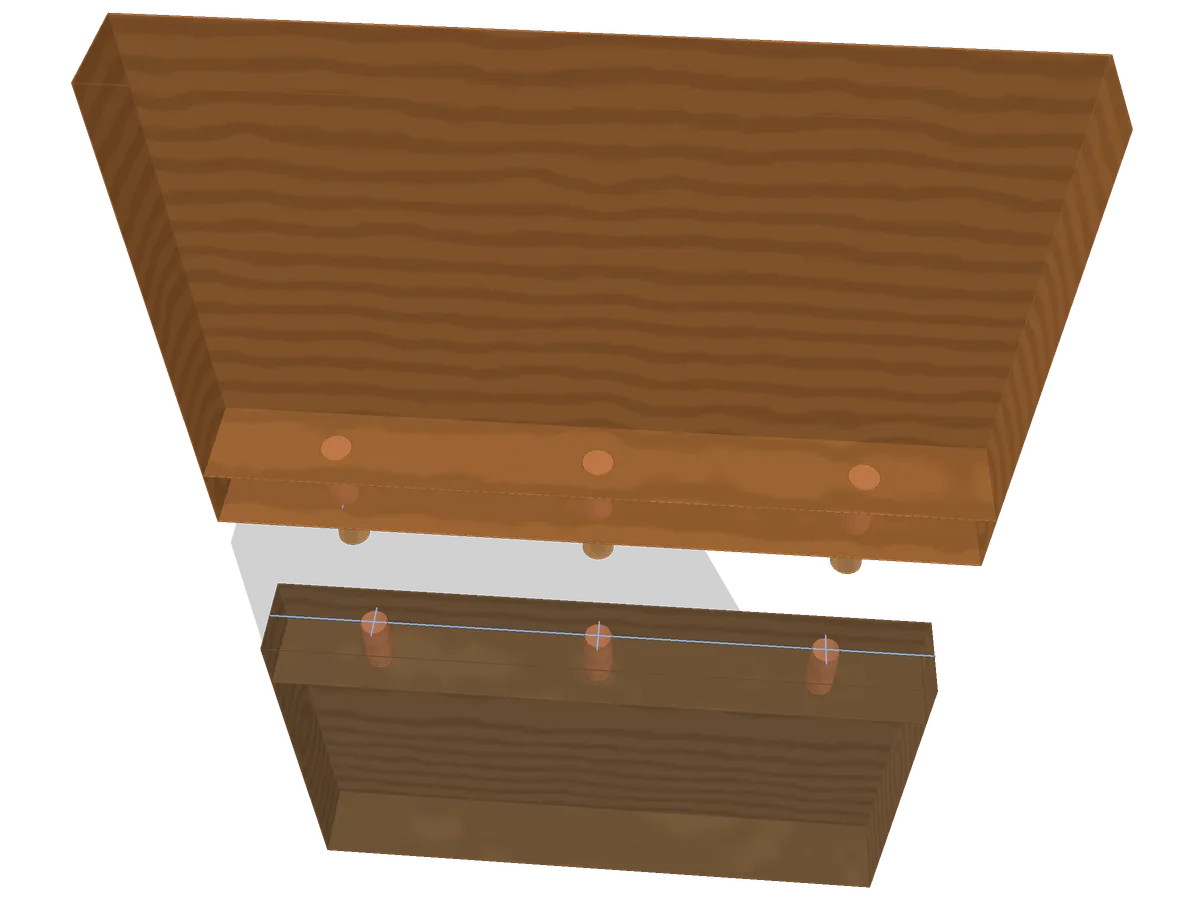
Two points, not a line, get marked here: a gauge run along the edge sets the height once, and a pencil tick crossing it at each dowel position sets where along the board. The pair of points that has to agree sits on two different boards, which is the entire difficulty of the joint.
- True and square both mating edges before any hole is bored; a dowel cannot fix an edge that does not sit flat against its partner.
- Set a marking gauge to the centre of the stock’s thickness and run it along both edges from the same face, so the two lines share one setting.
- Mark the dowel positions across that gauge line, working in from each end and spacing the rest evenly between them.
- Fit a dowelling jig to the edge, or clamp a fence that holds a brad-point bit square to it, and bore each mark to a depth a shade over half the dowel’s own length.
- Blow or vacuum the dust from every hole; packed dust at the bottom is what stops a pin from seating fully.
- Cut dowel pins to length, chamfer or groove them if they are plain, and dry-fit the pair of boards without glue.
- Check the faces for a step at every pin; a step means one bore disagrees with its partner and needs re-checking before glue goes anywhere near it.
- Glue both bores and the edge itself, drive the pins home, and clamp the joint flat until it cures.
Common mistakes
The pins are set in one board and the other is offered onto them. Bores that disagree side to side stop the boards closing; bores that disagree up and down let them close with a step across the faces, which a straightedge finds and a thumb finds faster.
The most common fault is a bore drilled off the gauge line’s own setting, so the pin sits proud or shy of where its partner expects it and the faces step at that point. Boring at an angle rather than square to the edge is the next: even a small tilt walks a deep hole well off centre by the time it reaches full depth, which is exactly what a dowelling jig exists to prevent. Skipping the dry fit is a third trap, since a bore that disagrees only shows up once the two boards are actually brought together, and by then glue in the holes makes correcting it far harder. Boring too shallow leaves no room for excess glue and can stop a pin from seating fully; too deep and the pin loses the bearing that keeps it from wobbling in the hole.
Dowel joint vs biscuit, mortise-and-tenon and butt joints
Choose a dowel joint when two edges need quick, hidden registration from a jig rather than a shoulder that resists racking; a biscuit, mortise and tenon or plain butt joint answers that different demand instead.
A biscuit joint reinforces an edge the same general way (a slot, a loose part, glue), but a biscuit’s oval slot gives it side-to-side play a round bore does not, which makes lining up two boards along their length considerably more forgiving than getting every dowel bore to agree.
A mortise and tenon carries real shoulder area and locks a frame against racking in a way a handful of round pins never will; dowelling trades that mechanical grip for speed and a much simpler set of cuts, which is a fair trade wherever the joint is not being asked to resist a twist.
Underneath the pins, a dowel joint is still the plain edge-to-edge meeting a butt joint describes, and Wikipedia’s own account files it as a reinforced form of exactly that joint. The dowels add registration during glue-up and a little resistance across the line; they do not change what is actually carrying the finished panel.
Variants
Through-dowelled joint. The bore runs all the way through one board rather than stopping blind, so the dowel’s own end grain shows on the outer face, a visible, sometimes decorative choice rather than a concealed one.
Dowelled frame corner. The same bored pins used end into face rather than edge to edge, registering a rail against a stile the way the mortise-and-tenon page’s own comparison describes, in situations too light to justify a full mortise and tenon.
Fluted dowel pins. Shallow grooves run down the length of the dowel let trapped glue and air escape as the pin is driven home, which reduces the risk of hydraulic lock splitting the hole in dense or dry stock.
Frequently asked questions
How many dowels does an edge joint need?
Enough to keep the faces from stepping while the glue grabs, spaced far enough apart that each hole has clean wall around it. A panel a metre long typically takes three or four; a short frame rail can manage on two.
What diameter should a dowel be?
A dowel much under a third of the stock’s own thickness leaves too little bearing in the hole and one much over it leaves too little wall on either face. A third to two-fifths of the thickness is a workable middle ground for most stock.
Why will my boards not close?
Almost always a bore drilled off the shared setting: the pins in one board stand a hair off line from the holes in the other, and the two edges bind before the faces ever touch. A dowelling jig removes most of that risk.
Is a dowel joint a butt joint?
By Wikipedia’s own account, yes: dowelling is filed as a reinforced form of the plain butt joint, since the two edges still meet flat and square. The pins add registration and a little shear resistance; they do not change the underlying geometry.
Sources and revision history
- Fairham, Woodwork Joints (The Woodworker Series, revised edition), the dowelling joint chapter (public domain)
- Wikipedia: Butt joint (the dowel-reinforced butt joint)
- Noyes, Handwork in Wood (1910), No. 8 "A doweled butt-joint" (public domain)
Revision history
- Published
- Last updated
Related joints
All wood joints
Every joint on the site, live and planned, grouped by how the pieces meet.
Biscuit joint
Compressed oval biscuits sit in crescent slots, swelling with glue to align two edges.
Mortise and tenon joint
The tenon enters a cut pocket; its shoulders land on the face and fix the angle.
Tongue and groove joint
A tongue on one edge sits in the groove of the next, keeping boards flush as they move.