Biscuit joint
Edge · Hidden · Power · Difficulty 1/5
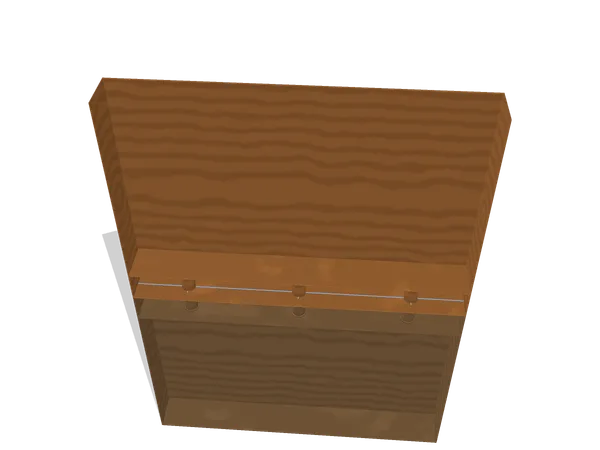
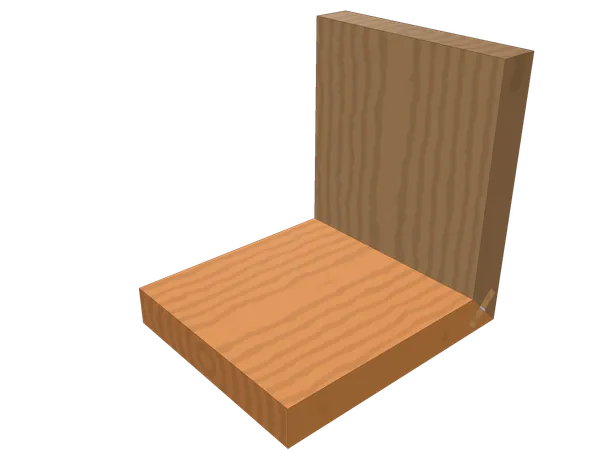
A biscuit joint cuts a crescent-shaped slot into each of two mating edges and glues a compressed oval of beech across the line between them. The biscuit swells as it takes up moisture from the glue and fills both slots, holding the faces level while the edge underneath is clamped.
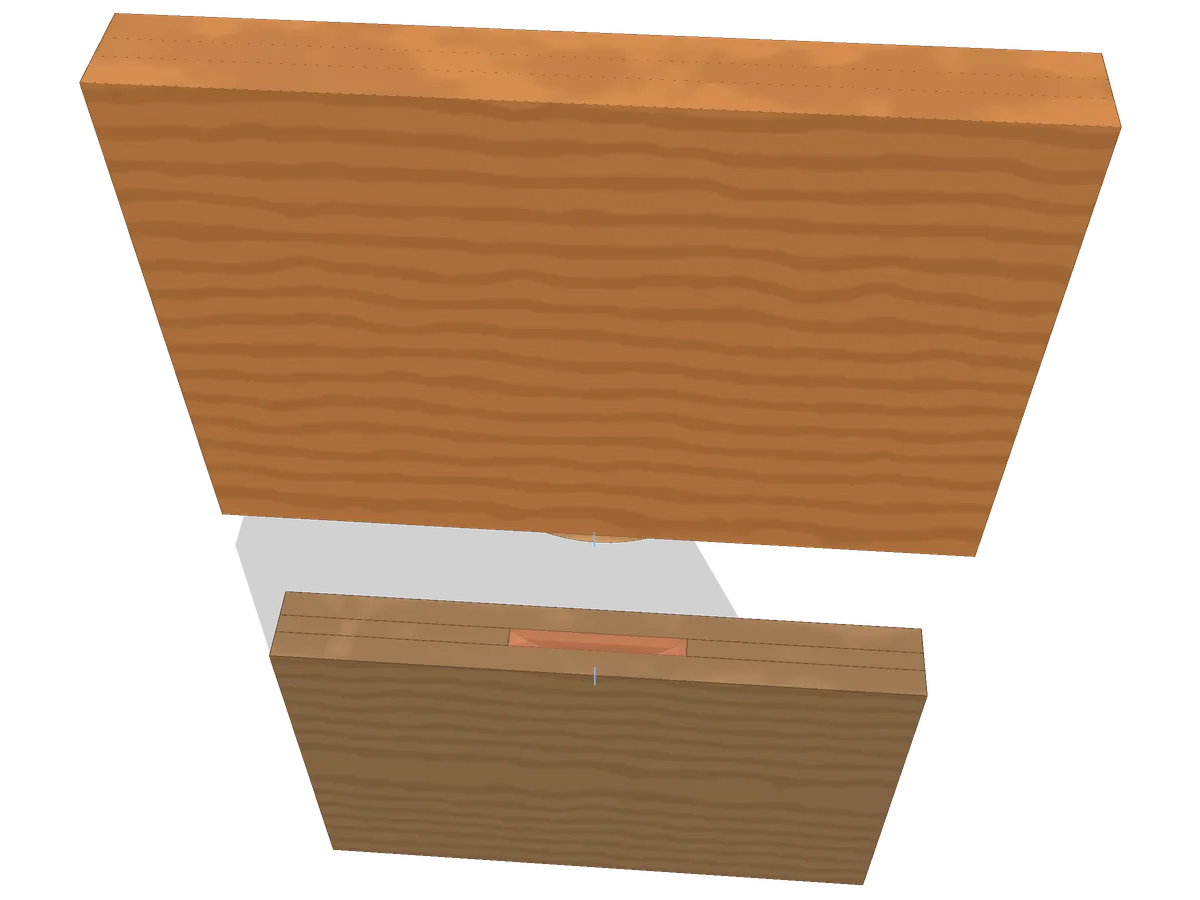
The 3D viewer stopped.
Mark out (1 of 4)
- Also called
- plate joint, plate joinery
- Family
- Edge · socket
- Joins
- two boards edge to edge
- Typical use
- edge-jointed panels and table tops; carcase panels in sheet material; face frames and mitred returns
- Holds against
- Shear (qualitative)
- Difficulty
- 1/5
- Tools
- biscuit joiner, pencil, clamps, straightedge
On this page
How the parts fit
Clamped, the biscuit spans the glue line with its own grain crossing from board to board, and it swells to fill both crescents. Its job is to hold the faces level while the edge is clamped; the long-grain joint underneath is what actually carries the panel.
A biscuit joint cuts a shallow, crescent-shaped slot into each of two mating edges and lets a thin, compressed oval of beech bridge the line between them. The slot is deliberately oversized: wider than the biscuit along the edge, and a little deeper than the biscuit is thick, so a dry-fitted joint has room to slide before it is brought to its final position. Once glue reaches the compressed wood the biscuit swells across its own width, filling the slot’s own height and gripping both faces without a clamp needing to hold the biscuit itself in place.
At 19 mm3/4 in stock and the default size class, each slot reaches roughly 12 mm1/2 in into the edge. None of that removes shoulder, cheek or socket the way a cut joint would; the biscuit only ever touches the slot it swells inside, and everything the panel actually leans on is the plain long-grain contact the two edges make either side of it.
When to use a biscuit joint (and when not to)
Where two edges need to line up flush with very little marking, and the joint will not be asked to resist a straight pull, a biscuit does the job: panel glue-ups, carcase sides in sheet goods, and face frames where the biscuit’s own work is registration rather than strength. The tool’s fence does almost all of the setting-out, which makes a run of many identical joints fast in a way hand layout rarely is.
There is no way to hide a blade that has gone too deep, which rules out stock too thin to take a slot without breaking through one face. It is also a poor choice wherever the joint genuinely needs to resist being pulled apart along the edge, because the slot’s own oversized shape gives the biscuit almost nothing to grip against in that direction. And without a biscuit joiner on hand there is no practical hand-tool substitute for cutting a clean segment slot, so the method depends on having the one tool it is named after.
Layout and cutting, step by step
A pencil tick crosses the joint line on both boards, and that is the whole layout. The tool’s own fence registers on the face rather than on the mark, so the tick only says where along the edge the slot goes. The height is the fence’s business, and the fence is what decides whether the faces finish level.
- True both mating edges square to their own faces; a slot cut into an edge that is not straight only carries the fault into the joint.
- Set the two boards face to face, or mark them from a shared reference face, and strike one pencil tick across the joint line at each biscuit position.
- Choose a biscuit size that leaves real wall on both faces of the stock, and set the tool’s own depth stop to match it.
- Register the tool’s fence on the reference face and plunge the slot at each tick, keeping every plunge on the same face-registered setting.
- Repeat on the mating board, using the same tick positions and the same face reference, so the two rows of slots share one setting.
- Dry-fit a biscuit into one slot and bring the boards together; it should stand slightly proud and enter the far slot with a little play, never a tight press.
- Spread glue in both slots and along the edges, seat the biscuits, and clamp the joint flat, sliding the boards along the line to true the ends before the glue grabs.
Common mistakes
Offered dry, the biscuit should stand proud of the edge rather than seat flush, and enter the opposite slot with a little side play. That looseness is deliberate: a compressed biscuit swells as soon as it takes up glue, and a slot that fits it dry will not close once it does.
The fault that shows up most often is a slot plunged from the wrong face, or with the fence resting on a surface that is not the one both boards were marked from: the two rows of slots then sit at different heights and the faces step once the joint is closed. Forcing a dry biscuit into a snug slot is a second trap: the slot is supposed to be loose before glue, and a biscuit that already binds dry will only bind harder once it swells. Gluing without sliding the boards to true the ends is a third: the oversized slot exists precisely so that adjustment can still happen after the biscuits are seated, and skipping it wastes the one advantage the joint has over a plain glued edge.
Biscuit joint vs dowel, splined-miter and butt joints
Reach for a biscuit when two edges need fast, hidden registration rather than a lock against pulling apart; a dowel, splined miter or plain butt joint suits an edge or corner asking for something else entirely.
A dowel joint registers an edge the same general way (a bored feature, a loose part, glue), but a round dowel in a round hole has none of the biscuit’s own side-to-side play, so getting every bore to agree with its partner takes more care than setting a biscuit joiner’s fence.
A splined miter joint reinforces a corner rather than a straight edge, and its spline is fitted snugly rather than left loose in an oversized slot; the two joints solve related problems with almost opposite tolerances.
Underneath the slots, a biscuit-reinforced edge is still the plain meeting a butt joint describes (Wikipedia’s own account files it as a reinforced variant of the same joint), with the biscuit adding alignment during glue-up rather than a new shape for the two edges to share.
Variants
Face-frame biscuits. The same slot and biscuit used to align stiles and rails in a face frame, where the biscuit’s own registration matters more than in a plain panel glue-up because the frame’s joints are visible and have to land flush from the first clamp.
Mitre-face biscuits. Slots plunged into the mitred faces of a corner rather than a straight edge, giving a mitre some of the registration a splined miter provides without the extra step of cutting a matching groove.
Knock-down biscuit fittings. Purpose-made plastic fittings that slot in the same way a wooden biscuit does but lock mechanically, letting a panel be assembled and taken apart repeatedly rather than glued once.
Frequently asked questions
Do biscuits add holding power or only alignment?
Mostly alignment. The biscuit’s own slot is cut longer than the biscuit on purpose, which is a poor shape for resisting a straight pull; what actually holds the panel together is the long-grain glue line the biscuit keeps level while it cures.
Which biscuit size should be used?
The largest one the stock’s own thickness and the joint’s own length can comfortably take, since a bigger biscuit spreads glue over more area. Thin stock or a short run of edge calls for the smaller named sizes instead.
Why is the slot longer than the biscuit?
So the two boards can slide a little along the joint line before the glue grabs, which is what lets their ends be brought flush at the last moment. A slot cut to the biscuit’s own exact length would remove that adjustment entirely.
Is a biscuit joint the same as plate joinery?
Yes: “biscuit” and “plate” both name the same compressed wooden wafer, and the tool that cuts its slot is called a biscuit joiner or a plate joiner depending on the maker. Nothing about the joint changes between the two names.
Sources and revision history
- Wikipedia: Biscuit joiner (the tool, the biscuit and the slot)
- Wikipedia: Butt joint (the biscuit-reinforced butt joint)
- Lamello: Lamello System (the biscuit-and-groove joining system)
Revision history
- Published
- Last updated
- : Added a trade source for the layout conventions.
Related joints
All wood joints
Every joint on the site, live and planned, grouped by how the pieces meet.
Dowel joint
Round pins in matched bored holes register two boards and carry the glue line between them.
Splined miter joint
Slotting a finished miter and setting a thin spline across the line adds long-grain gluing surface.
Tongue and groove joint
A tongue on one edge sits in the groove of the next, keeping boards flush as they move.