Dado joint
T-intersection · Either · Hand or power · Difficulty 2/5
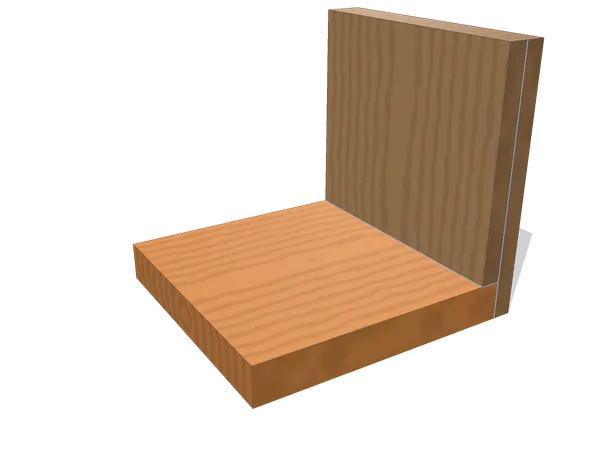
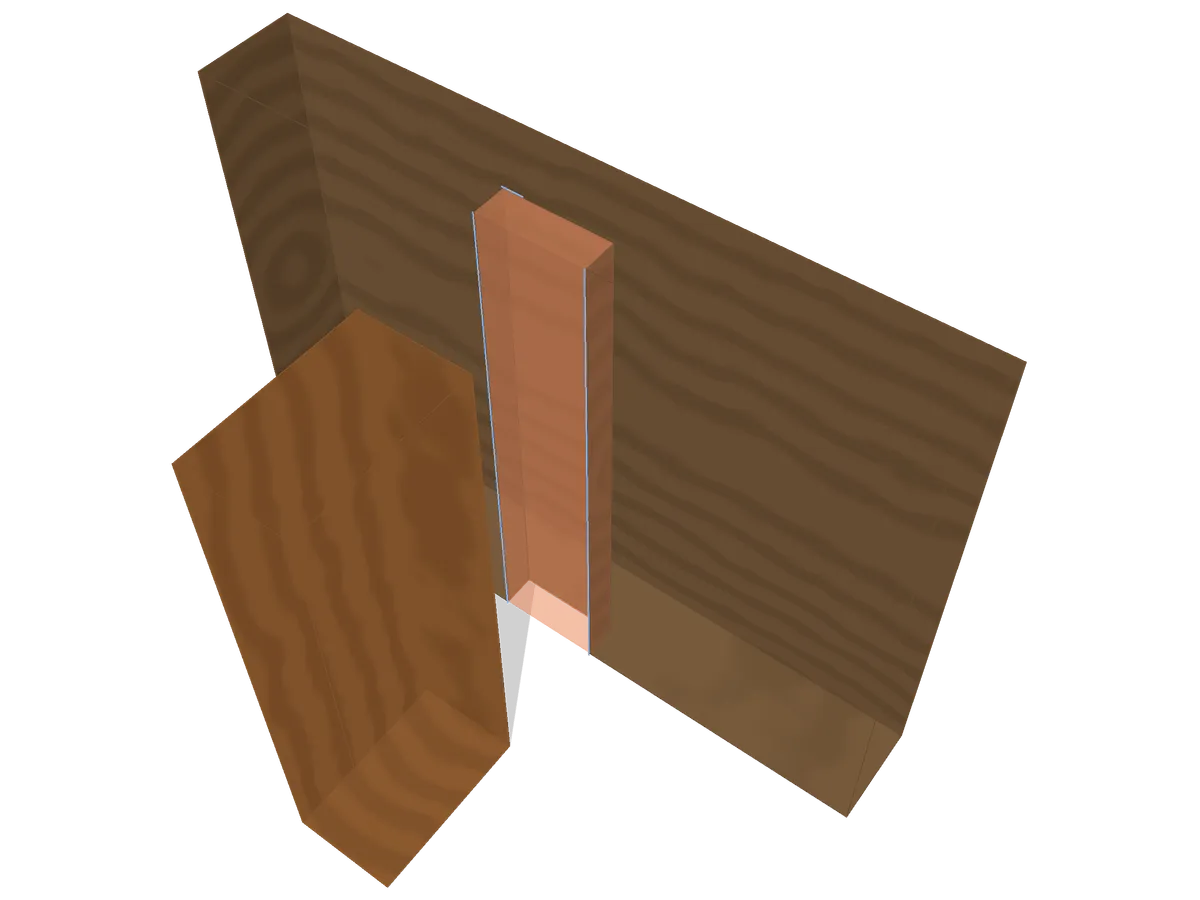
A dado joint (a housing, in British usage) houses the end of one board in a flat-bottomed trench cut across the grain of another. The shelf is held on three sides and needs no cutting of its own, which makes the fit a matter of trench width against board thickness.
The 3D viewer stopped.
Mark out (1 of 4)
- Also called
- housing joint, trench joint
- Family
- T-intersection · socket
- Joins
- the end of one piece into the face or edge of another
- Typical use
- fixed shelves in bookcases and cabinets; carcase partitions and dividers; drawer runners housed into sides
- Holds against
- Shear, Racking (qualitative)
- Difficulty
- 2/5
- Tools
- marking knife, marking gauge, tenon saw, wide bevel-edge chisel, router plane
On this page
How the parts fit
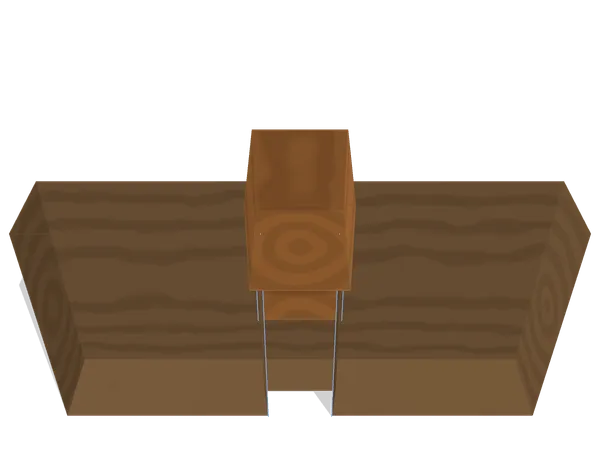
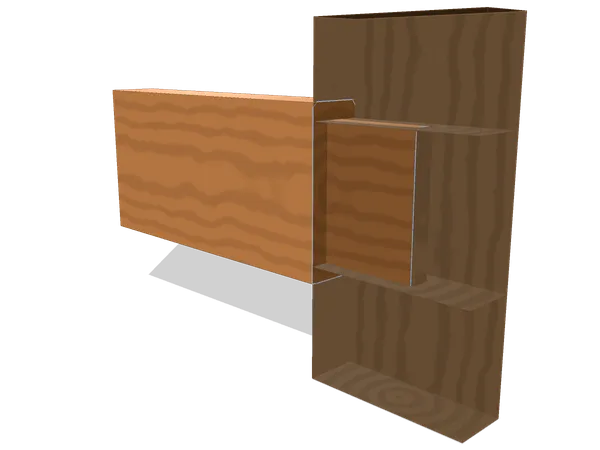
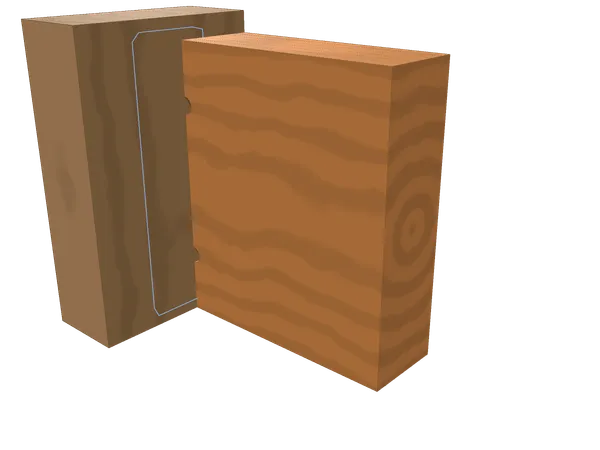
The shelf end is buried on three sides: a wall each side and a floor beneath. That is what carries a load bearing down on the shelf, and it is also why the joint does nothing at all against a pull straight out of the trench.
A dado is cut into the field of a board, not at its end, which is what separates it from a rabbet: the trench runs across the grain some distance in from the panel’s own edge, and the shelf’s end simply drops into it. Nothing about the shelf changes shape to get there: no shoulder, no step. The trench alone decides the fit.
Three surfaces do the work. The floor stops the shelf sinking any further and the two walls hold it square on either side. Cut a trench 18 mm11/16 in wide for a shelf of the same thickness and all three surfaces meet the wood with nothing left over; cut it wider or narrower and the mismatch shows at once, since nothing else in the joint compensates for it. That direct relationship between trench width and shelf thickness is what makes this the simplest fit in the set to check: hold the shelf up to the trench before either is finished and a straightedge tells the whole story.
The depth is set independently of the width, at roughly a third of the panel’s own thickness by default, deep enough to carry real load without leaving the trench floor too thin behind it. A deeper trench holds more of the shelf but takes more of the panel’s own thickness with it, and that trade is the one real decision this joint asks a maker to make.
When to use a dado joint (and when not to)
A dado earns its place wherever a shelf needs to sit at a fixed position along a panel and stay there under a load bearing straight down: fixed shelving, partitions inside a carcase, a drawer runner housed into a side. The three-sided grip does the registering, so the joint asks nothing of the shelf beyond being cut square and consistent in thickness.
If the load pulls the shelf back out of the trench rather than down into it, a stopped or dovetailed variant is the usual answer instead: a plain dado has no grip against that direction on its own. Thin panels rule it out too, since a useful trench depth can leave too little material behind the floor to carry real weight. And on a front edge that must read as one unbroken line, a dado’s own shoulder is exactly the mark this joint always leaves.
Layout and cutting, step by step
Both walls of the trench are knifed straight from the shelf that will sit in it, which is more reliable than setting a rule to a thickness that is never quite nominal. The depth is gauged down both edges of the panel from the face side.
- Mark the trench’s position along the panel with a pencil line, then set the shelf itself against the panel’s face to knife both walls directly from its own two edges.
- Square each knifed line fully across the panel with a try square, checking that both lines stay parallel before any tool touches the waste.
- Set a marking gauge to roughly a third of the panel’s own thickness and run it down both edges from the face side, carrying the depth line between the knife lines.
- Saw down both knife lines to the gauged depth, keeping the kerf inside the waste on each side so the trench does not creep wider than the shelf that fills it.
- Remove the bulk of the waste with a chisel, working from the middle out toward each wall, then true the floor flat with a router plane set to the gauge line.
- Check the floor with a straightedge along its whole width; a high spot anywhere stops the shelf from bedding fully even when both walls read correctly.
- Dry-fit the shelf. It should slide down to the floor under its own weight, with no gap at either wall and no rock when pressed from above.
Common mistakes
The shelf is lowered into the trench. Cut a shaving narrow and it will not start; cut wide and the shelf drops in and rocks between the walls, which is the fault that cannot be repaired by taking more material off.
A trench sawn a shade wide of the knife lines is the single most common fault, because the waste side of a cross-grain kerf is easy to misjudge, and there is no way to add material back once it is gone. Read the fit against the front edge before glue is anywhere near the joint.
Leaving the floor uneven is the next trap: a router plane run the trench’s whole width catches a high spot that a chisel alone tends to miss, and an uneven floor shows up as a shelf that rocks even when both walls are cut exactly to the lines. Gauging the depth from the back face instead of the face side gives the same fault by a different route: the trench still looks right until the shelf sits at a depth nobody measured for. And knifing the walls from a rule rather than from the shelf itself invites the one error this joint is built to avoid: a trench cut to a remembered number instead of the board that has to fill it.
Dado joint vs rabbet, sliding dovetail and butt joints
Pick a dado when a shelf sits mid-panel and only needs support from below; a rabbet, sliding dovetail or butt joint fits a corner, a shelf pulled outward, or a join with no trench at all.
A rabbet takes a step out of a board’s own end or edge and leaves the mating board entirely uncut; a dado instead trenches across a panel’s field and leaves the shelf itself uncut, so it is the panel rather than the shelf that carries every mark. Both give a floor to register against, but only the dado’s floor is flanked by a wall on each side.
A sliding dovetail cuts the same kind of cross-grain trench but flares its walls, so the shelf’s own end has to be worked to match, and the joint locks against being pulled straight out, the one thing a plain dado’s parallel walls cannot do. Everything a dado gets from three flat surfaces, a sliding dovetail buys with a taper and an extra cut on the shelf.
A butt joint dispenses with a trench altogether: the shelf’s end simply meets the panel’s face, held by fasteners or glue with no wood shaped to register it. It cuts faster than a dado in every way, and gives up the exact positioning and the three-sided grip that make a dado worth cutting.
Variants
Stopped dado. The trench ends short of the panel’s front edge rather than running all the way across, so no housing line shows once the shelf is fitted, more paring at the stopped end for a cleaner face.
Dado-and-rabbet. The shelf’s own end is rabbeted to leave a tongue that drops into a shallower trench, hiding the trench’s depth behind the shelf’s front edge for a cleaner meeting line.
Through dado. The trench runs the panel’s full width, edge to edge, with nothing stopped or hidden: the plainest version, and the one this route models.
Frequently asked questions
Is a dado the same as a housing?
Yes. Dado is the American and Canadian term; housing is the British word for the same flat-bottomed trench, and trench is what Europe generally calls it. All three name a shelf end captured on three sides across a panel’s grain.
How deep should a dado be?
Around a third of the panel’s own thickness is a common starting point: deep enough to hold real load without rocking, shallow enough to leave solid material under the trench floor. Too deep and that floor becomes the fragile part of the joint.
What is the difference between a dado and a groove?
Both are trenches cut into a board’s face, but a dado runs across the grain and a groove runs with it. A shelf end sits in a dado; a panel edge, or a drawer bottom, typically rides in a groove instead.
Why does my shelf rock in the trench?
A trench cut wider than the shelf leaves it free to tip between the walls, and no amount of glue fixes a gap that size. Check the fit against a straightedge before either surface is anywhere near finished.
Sources and revision history
- Noyes, Handwork in Wood (1910), the common joints chapter, No. 25 "A dado or grooved joint" (public domain)
- Wikipedia: Dado (joinery) (terminology and variants)
Revision history
- Published
- Last updated
Related joints
All wood joints
Every joint on the site, live and planned, grouped by how the pieces meet.
Rabbet joint
Along one edge runs a square step; the mating board sits into it and the corner registers.
Sliding dovetail joint
Tapered tail, matching housing: a shelf goes in from one end and slides home along it.
Mortise and tenon joint
The tenon enters a cut pocket; its shoulders land on the face and fix the angle.
Pocket-hole joint
Screws leave a bored pocket at a shallow angle and bite into the stile through the rail end.